


Bhastrika Pranayama: Benefits, Steps, Techniques, and Complete Guide
Introduction to Bhastrika Pranayama
Bhastrika Pranayama is a traditional yogic breathing practice known for its active and rhythmic inhalation and exhalation. The word Bhastrika comes from Sanskrit and means “bellows.” Just as a blacksmith uses bellows to supply air to a fire, this breathing technique involves moving air in and out of the lungs through controlled, energetic breathing.
Bhastrika Pranayama is an important breathing practice in Hatha Yoga. It is traditionally performed to cultivate energy, improve breathing awareness, support concentration, and prepare the mind and body for meditation.
Unlike slow breathing techniques, Bhastrika generally involves relatively forceful inhalation and exhalation. However, the intensity should always be appropriate for the practitioner’s health and experience. Beginners should start gently and learn the technique from a qualified yoga instructor.
Many people practice Bhastrika as part of their daily yoga routine because it combines conscious breathing, posture, and mental attention. Nevertheless, it is important to understand that traditional claims about its effects are not all supported by strong scientific evidence.
In this guide, you will learn what Bhastrika Pranayama is, how to practice it, its potential benefits, important precautions, common mistakes, and how to incorporate it safely into a yoga routine.
1. What Is Bhastrika Pranayama?
Bhastrika Pranayama is a yogic breathing technique characterized by active inhalation and active exhalation.
During ordinary relaxed breathing, inhalation is mainly produced by the diaphragm and other breathing muscles, while exhalation is generally passive. During Bhastrika, both phases are performed actively and rhythmically.
The practice is traditionally described as a way to stimulate the body and develop control over breathing.
Bhastrika is sometimes confused with Kapalabhati Pranayama. Although the techniques may appear similar, their traditional methods differ.
In Bhastrika, both inhalation and exhalation are active. In commonly taught Kapalabhati techniques, exhalation is active and inhalation is relatively passive.
The precise method and intensity can vary among yoga traditions. Therefore, beginners should learn the technique under appropriate guidance rather than immediately attempting rapid or forceful breathing.
2. Meaning and Significance of Bhastrika
The Sanskrit word Bhastrika means “bellows.”
A bellows pushes air toward a fire to increase the supply of oxygen needed for combustion. The breathing technique takes its name from this repeated movement of air.
In traditional yoga, pranayama refers to practices involving the regulation and awareness of breathing.
The word is commonly associated with prana, meaning vital energy, and ayama, meaning expansion or regulation.
Within yogic philosophy, breathing is considered closely connected with mental activity, attention, and the experience of vitality.
Bhastrika is traditionally practiced to cultivate alertness, support concentration, and prepare for meditation.
From a modern physiological perspective, active breathing changes the movement of air, engages respiratory muscles, and can influence carbon dioxide levels in the blood. Excessively rapid or forceful breathing may lower carbon dioxide too much, causing dizziness, tingling, or faintness.
For this reason, effective practice requires control rather than simply breathing as quickly or forcefully as possible.
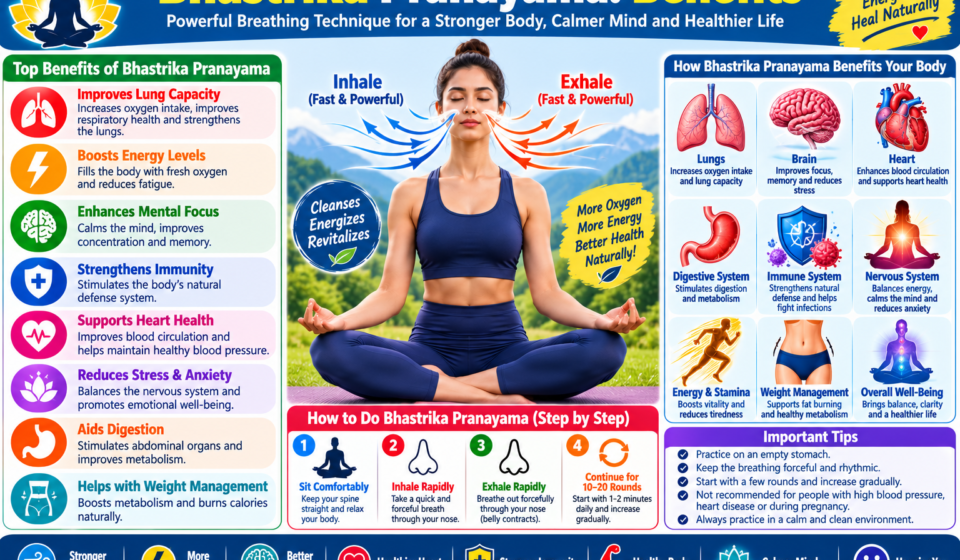
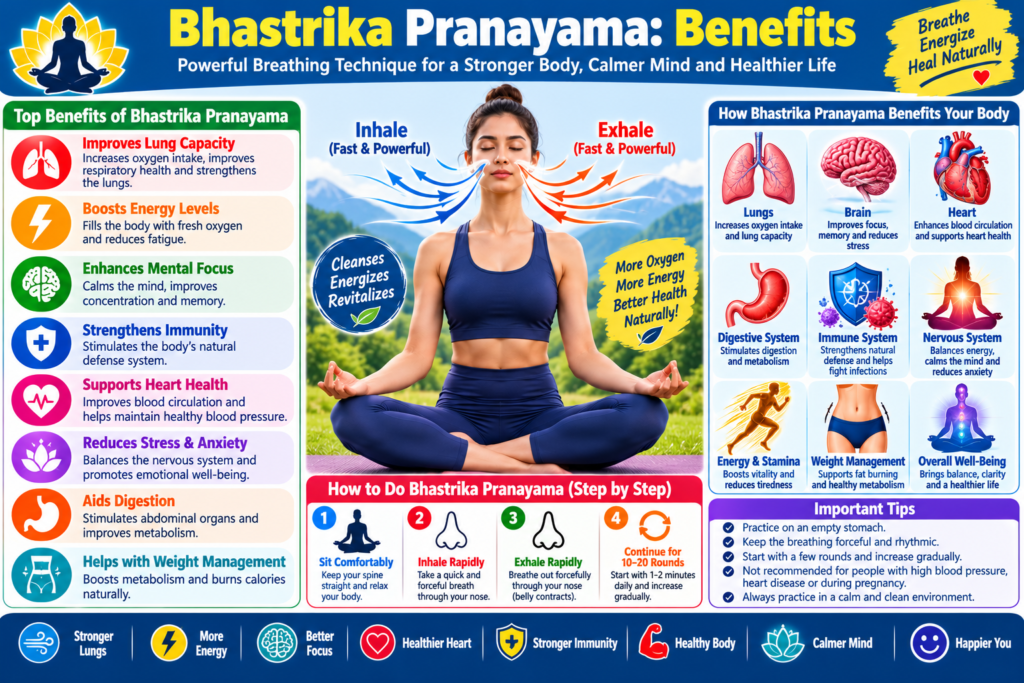
3. Benefits of Bhastrika Pranayama
Bhastrika is associated with several traditional yoga benefits. Some general effects of controlled breathing are supported by research, but direct scientific evidence for every claimed benefit of Bhastrika remains limited.
1. Develops Breathing Awareness
Bhastrika encourages practitioners to pay attention to inhalation, exhalation, and the movement of the chest and abdomen.
This awareness can help people become more conscious of their breathing patterns.
Learning to observe the breath is also useful in many other yoga practices and meditation techniques.
2. Engages the Respiratory Muscles
Because inhalation and exhalation are active, Bhastrika engages the muscles involved in breathing.
However, it should not be considered a replacement for medically recommended respiratory exercises or treatment for lung disease.
3. May Promote Alertness
Some practitioners find that active breathing makes them feel more awake and energized.
The experience varies from person to person. Rapid breathing can also cause discomfort or light-headedness, so a feeling of greater energy should not be pursued through excessive force.
4. Supports Relaxation and Mental Awareness
When practiced gently and with appropriate guidance, breathing exercises can help people develop greater awareness of their physical and mental state.
Some people find that including pranayama in a broader yoga routine helps them manage everyday stress.
However, Bhastrika is stimulating for some practitioners and may not be the best choice when someone feels anxious, panicky, or uncomfortable with forceful breathing.
5. May Complement a Meditation Routine
Bhastrika is traditionally used as preparation for meditation.
Practitioners may follow it with a period of quiet sitting, natural breathing, or a gentler breathing exercise.
Meditation itself involves training attention and observing thoughts without becoming overly involved in them.
6. Encourages Mind-Body Coordination
Coordinating posture, breathing, and attention can help practitioners develop greater awareness of bodily sensations.
Regular yoga practice may also encourage consistency, patience, and a more mindful approach to daily activities.
7. Forms Part of a Traditional Yoga Practice
Bhastrika has an established place in traditional yogic breathing practices.
For people interested in yoga philosophy and Hatha Yoga, learning Bhastrika can provide an opportunity to explore traditional approaches to breath regulation.
It should be understood as one component of a broader practice rather than a treatment for every physical or mental health problem.
Important: Bhastrika has not been conclusively shown to cure asthma, remove toxins, eliminate body fat, cure heart disease, or treat other medical conditions. It should not replace professional medical care.
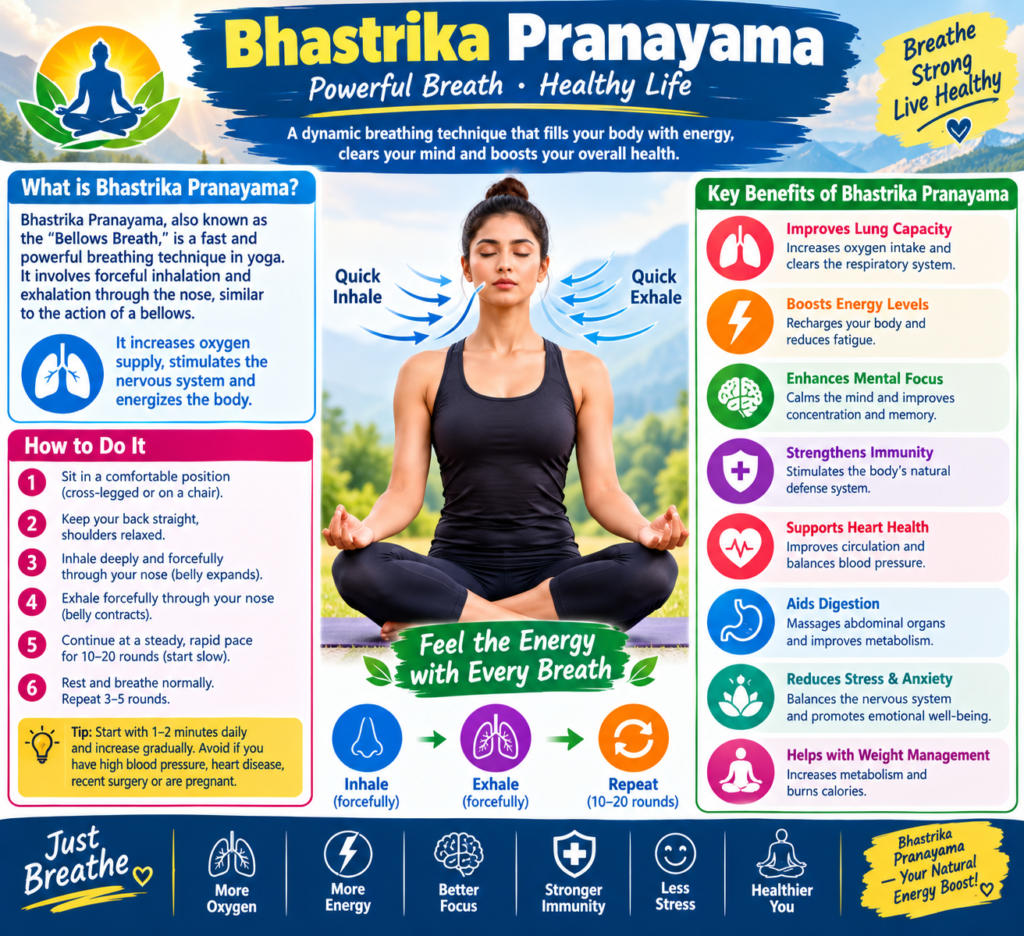
4. How to Perform Bhastrika Pranayama: Step-by-Step Guide
Beginners should learn the basic movement slowly before attempting faster breathing.
Step 1: Choose a Suitable Place
Find a quiet, clean, and well-ventilated space.
Choose a time when you are not immediately recovering from strenuous exercise or eating a heavy meal.
Morning may be convenient, but there is no universal requirement that Bhastrika must be practiced at a particular time.
Step 2: Sit in a Comfortable Position
Sit on a yoga mat, folded blanket, or firm cushion.
You may choose Sukhasana, the comfortable cross-legged posture, or sit upright on a chair with your feet supported.
Keep your spine comfortably upright, your shoulders relaxed, and your face free of unnecessary tension.
If sitting on the floor causes pain or discomfort, use a chair.
Step 3: Relax and Observe Your Natural Breath
Close your eyes if comfortable, or maintain a soft gaze.
Take several ordinary breaths without deliberately making them faster or deeper.
Notice the movement of your abdomen and chest.
Do not hold your breath or forcefully pull air into your lungs.
Step 4: Begin Gentle Active Breathing
Inhale actively through the nose, allowing the chest and abdomen to move naturally.
Exhale actively through the nose without straining.
Keep the movement controlled and reasonably comfortable.
At first, use a slow, manageable rhythm. Do not try to imitate the fastest demonstrations you may see online.
Step 5: Maintain a Comfortable Rhythm
Continue for a few breathing cycles while keeping your face, jaw, and shoulders relaxed.
The inhalation and exhalation should both be active, but neither should be so forceful that you feel pressure, pain, or breathlessness.
Stop if you feel dizzy, develop tingling, experience chest discomfort, or become unusually short of breath.
Step 6: Return to Natural Breathing
After a short practice, stop the active breathing and allow your breath to return to its normal rhythm.
Remain seated comfortably and observe how you feel.
Do not immediately stand up if you feel light-headed.
Step 7: End the Practice Calmly
Finish with one or two minutes of comfortable, natural breathing.
If you wish, you may follow the practice with gentle meditation or another suitable yoga exercise.
The purpose is to develop controlled breathing, not to achieve the greatest possible speed or intensity.
5. How Long Should Beginners Practice Bhastrika?
There is no single duration suitable for everyone.
A cautious beginner may start with only a few gentle breathing cycles under qualified instruction, followed by a period of natural breathing.
The duration can be adjusted according to comfort, experience, and medical suitability.
Avoid using a fixed number of rounds as a goal if the technique causes discomfort.
Beginners should not combine rapid breathing with prolonged breath retention unless specifically assessed and guided by a suitably qualified instructor.
People with relevant medical conditions should seek advice from their healthcare professional before attempting active pranayama.
6. Best Time to Practice Bhastrika Pranayama
Many yoga practitioners prefer practicing in the morning because it can be incorporated into a regular daily routine.
However, the best time depends on individual comfort and health.
Consider the following points:
- Choose a time when you can practice without rushing.
- Avoid practicing immediately after a heavy meal.
- Choose a comfortable, well-ventilated location.
- Avoid practicing when you are acutely unwell or struggling to breathe normally.
- Stop if the technique causes dizziness, discomfort, or unusual symptoms.
Consistency and appropriate technique are more important than following a rigid schedule.
7. Common Mistakes to Avoid During Bhastrika
Correct technique is important for a comfortable and controlled practice.
Breathing Too Forcefully
Forceful breathing can strain the respiratory muscles and may cause dizziness or discomfort.
Solution: Begin gently and increase intensity only if appropriate under qualified guidance.
Breathing Too Quickly
Excessive breathing can cause carbon dioxide levels to fall, potentially leading to tingling, light-headedness, or fainting.
Solution: Prioritize a controlled rhythm over speed.
Tensing the Shoulders and Face
Unnecessary muscle tension can make breathing less comfortable.
Solution: Keep the shoulders, jaw, forehead, and neck relaxed.
Holding the Breath Unnecessarily
Breath retention can add physiological stress, particularly when combined with forceful breathing.
Solution: Beginners should breathe continuously and avoid deliberate retention unless a qualified instructor has established that it is appropriate.
Ignoring Warning Symptoms
Dizziness, chest pain, severe breathlessness, or faintness should never be treated as signs that the exercise is working.
Solution: Stop immediately. Seek medical assessment if symptoms are severe, persistent, or concerning.
Practicing Without Considering Health Conditions
Some medical conditions may make vigorous breathing exercises unsuitable.
Solution: Consult a healthcare professional before practicing if you have cardiovascular disease, uncontrolled high blood pressure, significant respiratory disease, or another relevant health condition.
8. Who Should Avoid or Modify Bhastrika Pranayama?
Bhastrika can be too stimulating or physically demanding for some people.
Seek medical advice before attempting forceful breathing if you have:
- Uncontrolled high blood pressure.
- Significant heart disease or a history of serious cardiovascular problems.
- A respiratory condition that causes breathing difficulties.
- A history of fainting or unexplained dizziness.
- A condition affecting the eyes in which pressure changes may be dangerous, such as certain retinal disorders.
- Recent surgery or another medical condition for which straining is restricted.
- Pregnancy, particularly before attempting vigorous breathing or breath retention.
This is not an exhaustive list. Suitability depends on the individual’s medical history and the exact technique being used.
Children, older adults with significant health conditions, and people recovering from illness should receive appropriate professional guidance.
If you experience chest pain, severe shortness of breath, or loss of consciousness, seek emergency medical attention.
9. Difference Between Bhastrika and Kapalabhati Pranayama
Bhastrika and Kapalabhati are both traditional yogic breathing techniques, but their commonly taught methods differ.
Bhastrika Pranayama:
- Both inhalation and exhalation are active.
- The breathing resembles the repeated movement of bellows.
- It is traditionally used as a stimulating breathing practice.
Kapalabhati Pranayama:
- Exhalation is active and relatively forceful.
- Inhalation is generally passive.
- It is traditionally described as a cleansing practice in yoga.
The techniques can look similar in demonstrations, and teaching methods vary across traditions.
Neither technique should be performed at excessive speed or intensity. Beginners should learn the difference from a qualified yoga instructor.
10. How Bhastrika Fits into a Daily Yoga Routine
A balanced yoga routine can include postures, breathing awareness, relaxation, and meditation.
For example, a beginner’s routine might involve:
- A few minutes of comfortable sitting.
- Gentle movements to prepare the body.
- Natural breathing to establish awareness.
- Instructor-guided pranayama appropriate to the individual’s health.
- Quiet sitting or meditation.
- A short relaxation period.
Bhastrika does not need to be included every day, and more intense practice is not necessarily better.
The routine should be adapted to individual needs rather than following an inflexible schedule.
If your primary goal is relaxation, gentle breathing practices may be more suitable than vigorous Bhastrika.
If your goal is to learn traditional pranayama, a qualified teacher can help you select appropriate techniques and develop your practice gradually.
11. Scientific Perspective on Bhastrika Pranayama
Modern research has examined various yoga-based breathing techniques and their possible effects on stress, respiratory function, heart rate, and blood pressure.
However, studies differ in their methods, participant groups, breathing protocols, and overall quality.
Evidence supporting slow, controlled breathing in some settings should not automatically be interpreted as proof that vigorous Bhastrika provides the same effects.
Bhastrika can change breathing patterns and respiratory muscle activity. If performed too rapidly, it may reduce carbon dioxide in the blood and produce unpleasant symptoms.
Therefore, claims that Bhastrika reliably cures disease, permanently increases lung capacity, or guarantees improved cardiovascular health should be treated cautiously.
For general health, pranayama is best considered a possible complement to appropriate exercise, healthy nutrition, adequate sleep, and medical care when needed.
12. Frequently Asked Questions About Bhastrika Pranayama
What is Bhastrika Pranayama?
Bhastrika Pranayama is a traditional yogic breathing technique involving active inhalation and active exhalation. It is also known as bellows breathing.
What are the main benefits of Bhastrika?
Practitioners use it to develop breathing awareness, coordinate breathing with attention, and prepare for meditation. Some people also report feeling more alert. Scientific evidence for specific health benefits remains limited.
Can beginners practice Bhastrika?
Beginners can learn a gentle version under qualified instruction, provided the technique is appropriate for their health. They should avoid rapid breathing and prolonged breath retention.
Is Bhastrika the same as Kapalabhati?
No. In commonly taught Bhastrika, both inhalation and exhalation are active. In Kapalabhati, exhalation is active and inhalation is relatively passive.
Can Bhastrika cure asthma?
No. Bhastrika is not an established cure for asthma. People with asthma should consult their healthcare professional before attempting vigorous breathing exercises and should continue their prescribed treatment.
Should Bhastrika be practiced on an empty stomach?
Many yoga traditions recommend practicing pranayama before eating or after sufficient time has passed following a meal. Avoid practicing immediately after a heavy meal, and follow the advice of your qualified instructor.
What should I do if I feel dizzy?
Stop immediately and return to comfortable, natural breathing. Sit or lie down safely until the symptoms resolve. Seek medical care if symptoms persist, are severe, or occur with chest pain, fainting, or significant breathlessness.
Conclusion
Bhastrika Pranayama is a traditional yogic breathing technique characterized by active inhalation and exhalation. Its name refers to the bellows used to move air, reflecting the rhythmic nature of the practice.
Learning the correct technique involves maintaining a comfortable posture, coordinating the breath, avoiding unnecessary strain, and allowing the body to return to natural breathing afterward.
Bhastrika may be a useful part of a broader yoga routine for people who can practice it safely. However, its potential benefits should not be exaggerated, and it should not replace medical treatment.
Beginners should start gently, learn from a qualified instructor, and pay attention to their body’s response. People with cardiovascular, respiratory, or other relevant medical conditions should seek professional advice before practicing.
The key principle of Bhastrika Pranayama is controlled breathing, not force or speed. A safe, consistent, and appropriately guided practice is more valuable than pushing beyond your limits.
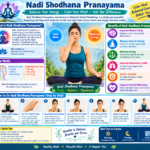
Image Alt Text: Bhastrika Pranayama breathing technique demonstrated in a seated yoga posture.
Related Keywords:
- Bhastrika Pranayama benefits
- How to do Bhastrika Pranayama
- Bhastrika breathing technique
- Bhastrika Pranayama steps
- Bhastrika Pranayama precautions
- Bellows breathing yoga
- Yoga breathing exercises
- Bhastrika vs Kapalabhati
- Pranayama for beginners
- Traditional yogic breathing

[…] Some traditions distinguish Nadi Shodhana by including specific breathing ratios, breath retention, or additional practices. Other teachers use the terms for essentially the same basic alternate nostril breathing exercise.Bhastrika Pranayama: Benefits […]