
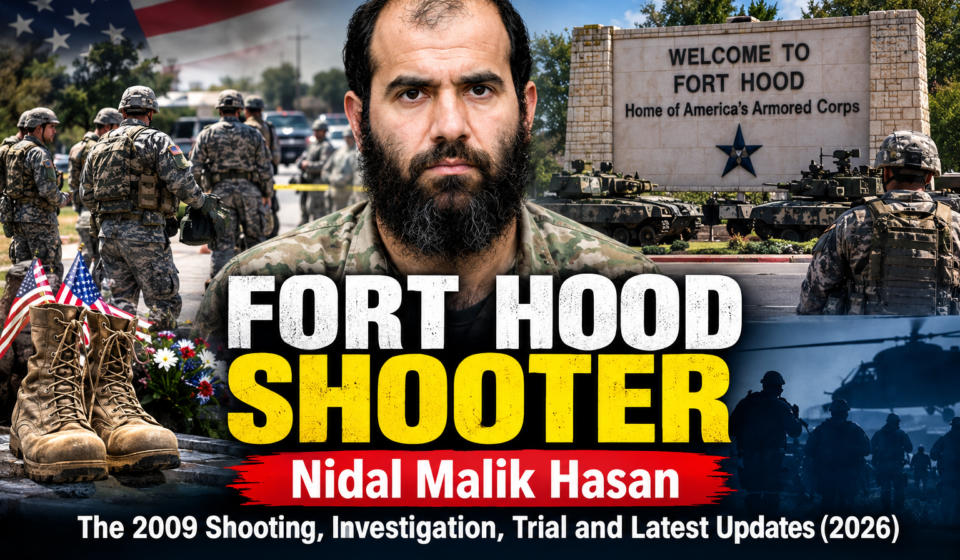


Fort Hood Shooter: Nidal Malik Hasan — The 2009 Shooting, Investigation, Trial and Latest Updates (2026)
Introduction
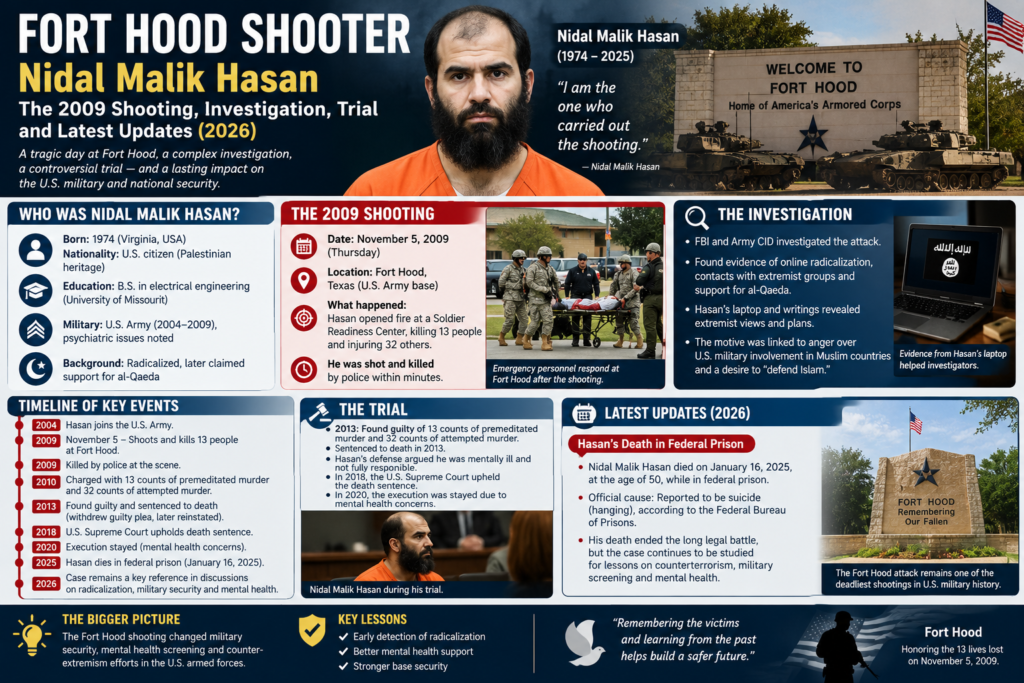
The Fort Hood shooting was one of the most shocking acts of violence in modern United States military history. On November 5, 2009, a gunman opened fire at the Soldier Readiness Processing Center at Fort Hood, a major U.S. Army installation in Texas. The attack killed 13 people and injured 32 others. Most of the victims were military personnel preparing for their next assignments or deployments.
The shooter was identified as Nidal Malik Hasan, a U.S. Army major and psychiatrist who had been serving at Fort Hood. His position made the attack particularly disturbing because he was a military officer and medical professional entrusted with responsibilities involving the well-being of fellow soldiers.
The incident raised serious questions about workplace security, military preparedness, intelligence sharing, the identification of potential threats, and the prevention of extremist violence. It also prompted a national debate about how the military should respond when concerns arise about a service member’s conduct or beliefs.
Hasan was eventually convicted by a military court and sentenced to death in 2013. As of October 2026, his case has returned to the headlines because of developments concerning his planned execution.
This article explains the background of the Fort Hood shooting, the events of November 5, the victims, the investigation, the trial, and the continuing significance of the case.
1. What Was the Fort Hood Shooting?
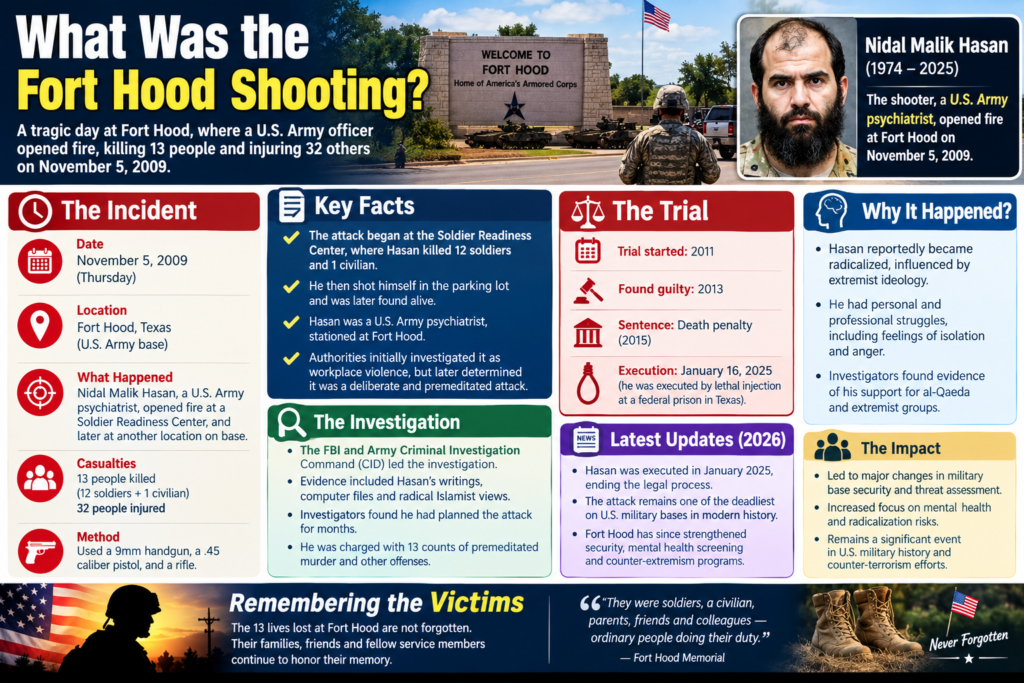
The Fort Hood shooting was a mass shooting that occurred on November 5, 2009, at Fort Hood, a U.S. Army installation near Killeen, Texas.
The attack took place at the Soldier Readiness Processing Center, where military personnel completed administrative and medical procedures connected with their military assignments. Soldiers regularly visited the facility to prepare for deployments and other duties.
The gunman was Nidal Malik Hasan, an Army major who worked as a psychiatrist.
According to official accounts, Hasan opened fire inside the facility, killing 13 people and wounding 32 others. Military personnel, emergency responders, and law enforcement officers acted quickly to stop the attack.
The incident became a major national news story because of the number of casualties, the military setting, and the fact that the suspected attacker was himself an Army officer.
The FBI subsequently investigated the shooting, while military authorities conducted legal proceedings that ultimately resulted in Hasan’s conviction.
2. Who Was Nidal Malik Hasan?
Nidal Malik Hasan was a U.S. Army officer and psychiatrist. Before the shooting, he had received medical training and worked in military healthcare.
As a psychiatrist, his professional responsibilities involved evaluating and treating mental health concerns. His position placed him in a particularly sensitive role within the military community.
Hasan’s military career included medical training and service in the Army. However, concerns about his views and communications later became an important part of investigations into the circumstances surrounding the attack.
Investigators examined his background, his contacts, and information that government agencies had possessed before November 5, 2009.
The investigation became controversial partly because some information about Hasan’s communications and attitudes had reached government officials before the shooting. This prompted questions about whether warning signs had been adequately evaluated.
It is important to distinguish established facts from speculation. Hasan was convicted of the murders and attempted murders associated with the attack. Explanations of his motivations should be grounded in the evidence presented during the investigation and trial rather than assumptions about his religion or personal background.
3. What Happened on November 5, 2009?
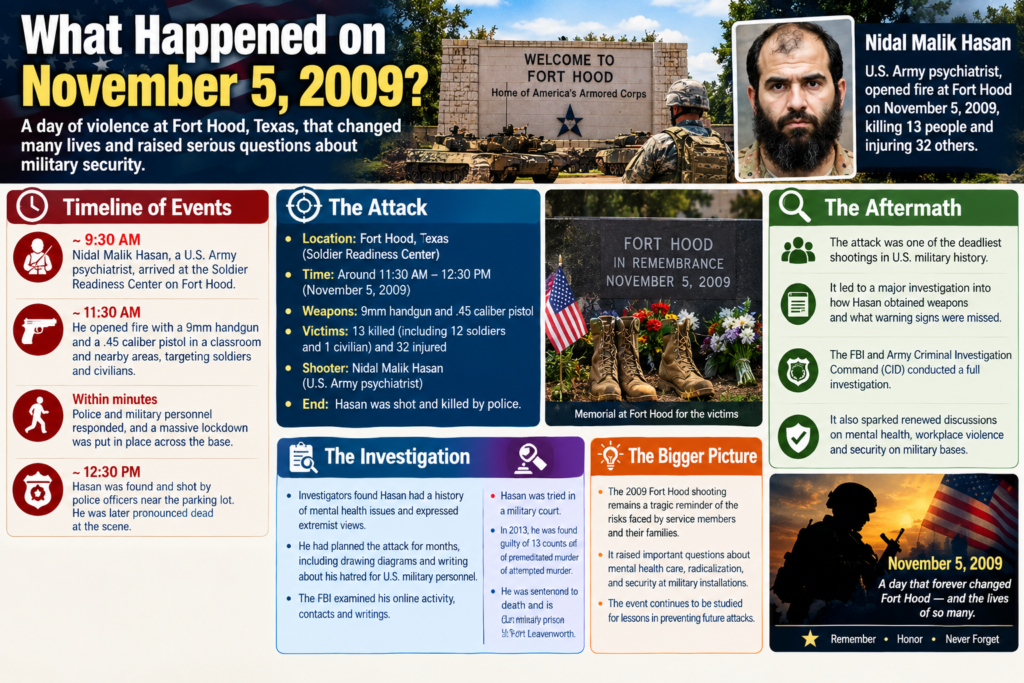
On the afternoon of November 5, 2009, Hasan opened fire inside the Soldier Readiness Processing Center at Fort Hood.
The location was occupied by military personnel carrying out routine administrative and medical preparations. What began as an ordinary day quickly became a deadly emergency.
Gunfire caused panic as people attempted to escape, find shelter, assist injured colleagues, and alert emergency services.
Military personnel and first responders moved rapidly toward the scene. Emergency services worked to provide medical assistance and transport injured people to hospitals.
A civilian police officer, Kimberly Munley, confronted Hasan and shot him during the incident. Hasan was seriously wounded but survived and was taken into custody.
The rapid response by the officer and other personnel helped bring the attack to an end.
The incident resulted in 13 deaths and 32 wounded victims. The tragedy affected not only those present at the processing center but also families, military colleagues, and the wider Fort Hood community.
Official government reviews later praised the speed and effectiveness of the emergency response while also examining broader security and intelligence issues.
4. The Victims and Their Families
The human cost of the Fort Hood shooting extended far beyond the immediate crime scene.
Thirteen people lost their lives, leaving families, friends, and military colleagues to cope with sudden and devastating losses. Thirty-two others were wounded, and survivors faced physical injuries and emotional consequences.
For military families, the attack was particularly painful because service members often accept significant risks while serving their country. A shooting inside a military installation created an additional fear: that personnel could face lethal violence in a place where they expected to work safely.
The families of the victims had to navigate grief, funeral arrangements, medical concerns, and the long process of rebuilding their lives.
Survivors also faced difficult questions about returning to work, dealing with trauma, and finding support after the incident.
The tragedy highlighted the importance of providing long-term assistance to victims and their relatives. Support may include medical treatment, psychological care, financial assistance, and access to information about investigations and legal proceedings.
Remembering the Fort Hood victims is essential to understanding the event. The case should not be viewed only through the identity of the attacker or the details of the criminal trial. It is also a story about the people whose lives were lost or permanently changed.
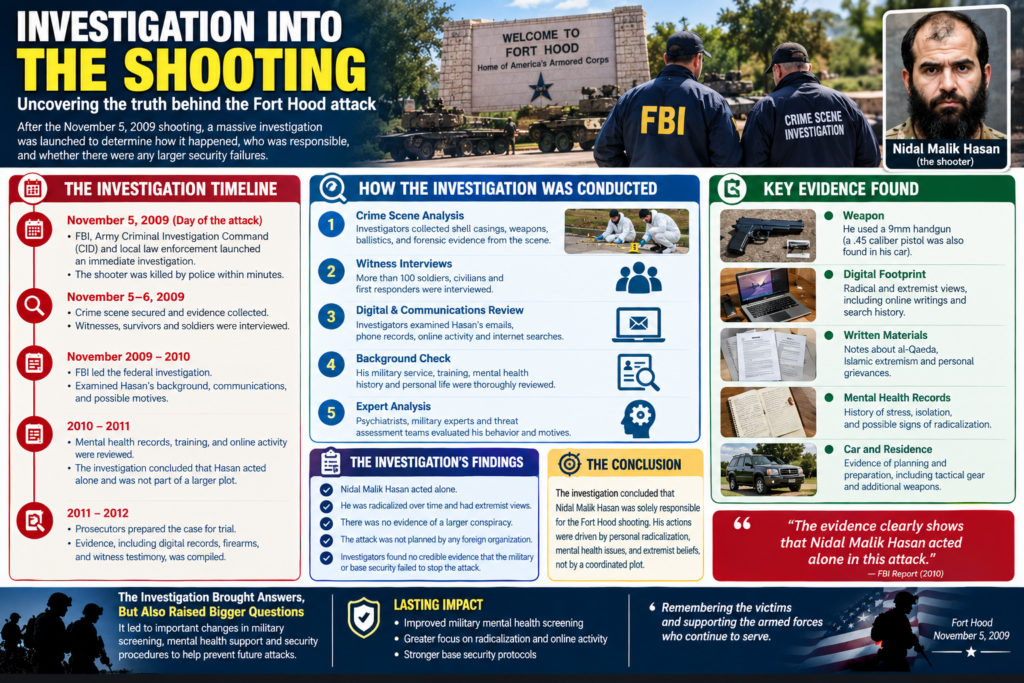
5. Investigation Into the Shooting
The investigation involved military authorities, the FBI, and other government agencies.
Investigators examined the crime scene, collected evidence, interviewed witnesses, and reviewed information about Hasan’s background and communications.
The FBI also investigated whether the shooting had connections to extremist ideology or contacts outside the United States military.
One significant issue was whether government agencies had received information about Hasan before the attack that should have prompted additional action.
Officials reviewed communications and records to determine what was known before November 5, 2009, and how that information had been handled.
These reviews raised broader questions about how intelligence information should be shared between agencies and how officials should respond to potentially concerning behavior without relying on unsupported assumptions.
The case demonstrated that intelligence gathering is not simply a matter of collecting information. Authorities must also evaluate its significance, communicate relevant findings, and determine whether further investigation or protective measures are justified.
At the same time, investigations must respect legal standards and distinguish credible evidence of a threat from conduct that does not establish criminal intent.
The Fort Hood case therefore became an important example in discussions about intelligence coordination, military security, and threat assessment.
6. Why Did Hasan Carry Out the Attack?
Hasan’s motivations became a central issue during the investigation and trial.
Evidence presented in the proceedings connected the attack to his opposition to U.S. military operations in Muslim-majority countries and his extremist views.
During the legal proceedings, Hasan acknowledged that he had turned against the United States military and argued that he had acted to protect Muslims from American military operations.
These statements formed part of the broader examination of his motivations.
However, it is important to avoid treating the actions of one individual as representative of an entire religion or community. Hasan’s criminal responsibility was established through evidence concerning his own actions and intentions.
The case illustrates the danger of extremist thinking when an individual comes to regard violence against fellow human beings as justified by a political or ideological cause.
It also highlights the importance of taking credible threats seriously while avoiding prejudice against people based solely on religion, ethnicity, or national origin.
Understanding the attack requires examining the evidence, the perpetrator’s own statements, and the failures or limitations identified in the security system. It does not require making broad claims about any wider community.
7. Security Failures and Government Reviews
Following the shooting, the U.S. government conducted reviews of the incident and the handling of information about Hasan.
These reviews examined the effectiveness of intelligence sharing, military procedures, and systems designed to identify potential threats.
One major concern was whether separate pieces of information held by different officials had been connected and evaluated appropriately.
When information is distributed across multiple departments, an important warning can be overlooked if no individual or team has responsibility for examining the complete picture.
The Fort Hood investigation encouraged discussion about improving communication between intelligence agencies, military commanders, and law enforcement authorities.
Another issue involved the balance between security and individual rights. Military organizations need systems for addressing credible risks, but decisions must also be based on reliable evidence and established procedures.
The incident also reinforced the need for emergency preparedness. Training, communication systems, medical response planning, and coordination between military and civilian authorities can make a substantial difference during a mass-casualty event.
No security system can guarantee that every attack will be prevented. Nevertheless, reviewing past incidents can help organizations identify weaknesses and reduce the likelihood of similar tragedies.
8. The Military Trial of Nidal Malik Hasan
Hasan faced a military court-martial for his role in the shooting.
The trial took place in 2013 and attracted considerable public attention. Hasan represented himself during the proceedings, although a military judge supervised the case and legal procedures.
The prosecution presented evidence concerning the attack and the deaths and injuries suffered by the victims.
Hasan was charged with 13 counts of premeditated murder and 32 counts of attempted premeditated murder.
On August 23, 2013, the military jury found him guilty on all charges.
The verdict established his criminal responsibility for the killings and attempted killings.
The case was unusual because Hasan was a commissioned Army officer being prosecuted for murdering fellow service members and other people at a military installation.
The proceedings also raised questions about courtroom strategy, the responsibilities of military judges, and the administration of justice in cases involving mass violence.
Despite the complexity and publicity surrounding the trial, the central legal issue was whether the prosecution had proved the charges against Hasan. The military jury concluded that it had.
9. Why Was Hasan Sentenced to Death?
After the guilty verdict, the court-martial proceeded to the sentencing phase.
On August 28, 2013, the military jury sentenced Hasan to death.
The sentence reflected the gravity of the offenses, which involved the deliberate killing of 13 people and the attempted murder of 32 others.
Military death sentences are subject to special legal procedures and review requirements. A sentence cannot be carried out simply because a jury has imposed it; the applicable military justice and executive authorization processes must also be satisfied.
The Fort Hood case became one of the most prominent examples of the U.S. military justice system imposing a death sentence in a mass-casualty crime.
The sentence also generated debate about capital punishment. Supporters argued that the scale and deliberate nature of the murders justified the ultimate penalty. Opponents of capital punishment questioned whether execution is an appropriate response, even in exceptionally serious cases.
These disagreements reflect broader debates about punishment, deterrence, justice for victims, and the role of the state.
Whatever position people take on the death penalty, the legal outcome in Hasan’s case followed his conviction by a military jury.
10. The 2014 Fort Hood Shooting
The 2009 massacre was not the only shooting at Fort Hood.
On April 2, 2014, another shooting occurred at the Army installation. The gunman, Ivan Lopez, was an active-duty soldier who opened fire at several locations on the base.
Three soldiers were killed and 12 people were wounded. Lopez died by suicide after being confronted by a military police officer.
The 2014 incident was separate from the 2009 attack and involved a different perpetrator and different circumstances.
The two events are sometimes confused because both occurred at Fort Hood and involved members of the U.S. military.
However, the cases must be distinguished carefully. Nidal Malik Hasan was convicted for the 2009 shooting, while Ivan Lopez was responsible for the 2014 incident.
Together, the incidents reinforced concerns about installation security, emergency response, and the challenges of preventing violence within military communities.
They also demonstrated the importance of evaluating each event on its own evidence rather than assuming that two attacks at the same location necessarily share the same cause.
fort hood shooterfort hood shootingfort hoodnidal malik hasanfiring squad executionfort hood shooter executionfiring squadpublic execution usanidal hasan executionnidal hassanpublic executions in the uspublic execution fort hoodexecutionfort hood shooting what happenedwhere is fort hoodhegseth firing squadfort hood executionpentagonfort hood shooter execution datenidal malik2009 fort hood shootingnidal hasan execution dateexecution by firing squad in the usdeath by firing squadfiring squad fort hoodpete hegseth firing squad
11. The Lasting Impact on Fort Hood
The Fort Hood shooting had a lasting impact on the military community and the families connected to the installation.
The deaths and injuries created enduring grief. Survivors and relatives continued to face the consequences of the attack long after the immediate emergency ended.
The incident also influenced discussions about how military installations should prepare for violent emergencies.
Lessons drawn from the case included the need for effective communication, coordinated emergency response, careful handling of intelligence, and appropriate mechanisms for reporting credible concerns.
Military organizations must protect personnel while ensuring that information is evaluated fairly and that decisions follow established procedures.
The tragedy also underscored the importance of mental health services and support for military personnel. Mental health care should not be treated as a substitute for security investigations, nor should mental health difficulties automatically be interpreted as evidence of dangerousness.
Effective prevention requires a balanced approach involving credible threat assessment, responsible leadership, appropriate security measures, and accessible support services.
The Fort Hood shooting remains a significant case study for military institutions, law enforcement agencies, researchers, and policymakers.
4 Pack Women’s Long Sleeve Workout Tops
12. Latest Update on the Fort Hood Shooter in 2026
As of October 2026, Nidal Malik Hasan remains at the center of renewed public attention because of developments concerning his death sentence.
Recent reports from major news organizations state that U.S. authorities have authorized his execution by firing squad and scheduled it for December 3, 2026, at Fort Hood.
The announcement has prompted debate about military capital punishment, execution procedures, and the unusual nature of a planned military execution after decades without one.
However, a scheduled execution date does not necessarily mean that the execution has already occurred. Legal procedures or court challenges may affect the timing.
Readers should therefore distinguish between the announced schedule and a confirmed completed execution.
The developments have also renewed discussion about whether executions should be publicly broadcast, how military death sentences should be carried out, and what standards of transparency should apply.
Supporters of the planned execution argue that Hasan’s conviction and the deaths of 13 victims justify carrying out the sentence. Critics of capital punishment raise concerns about the ethics of state executions and the consequences of turning them into public spectacles.
These debates are separate from the established facts of the original crime: Hasan was convicted in 2013 of 13 counts of premeditated murder and 32 counts of attempted premeditated murder.
For the most reliable updates, readers should consult official U.S. Army announcements and established news organizations.
13. Lessons Learned From the Fort Hood Shooting
Several important lessons can be drawn from the Fort Hood tragedy.
First, credible threats must be assessed carefully. Organizations should have clear procedures for reporting and evaluating information that may indicate a serious risk.
Second, intelligence sharing matters. Relevant information can lose its value if agencies fail to communicate or evaluate it effectively.
Third, emergency preparedness saves lives. Training, communication, medical response, and coordination among responders can reduce the consequences of a violent incident.
Fourth, victims and survivors need long-term support. Recovery may involve medical treatment, psychological care, financial assistance, and continued help for family members.
Fifth, accountability must follow due process. Even in highly publicized cases, criminal responsibility must be established through appropriate legal proceedings.
Finally, extremism must be confronted without collective blame. Individuals should be held responsible for their own actions. The crimes of one person should not be used to stigmatize an entire religious or cultural community.
These lessons remain relevant to military installations, workplaces, public institutions, and communities seeking to prevent violence.
Frequently Asked Questions (FAQ)
1. Who was the Fort Hood shooter?
The shooter responsible for the 2009 Fort Hood attack was Nidal Malik Hasan, a U.S. Army major and psychiatrist.
2. When did the Fort Hood shooting happen?
The shooting occurred on November 5, 2009, at Fort Hood in Texas, United States.
3. How many people died in the 2009 Fort Hood shooting?
Thirteen people were killed. Thirty-two others were wounded.
4. Why did Nidal Malik Hasan attack fellow soldiers?
Evidence presented during the trial connected his actions to extremist views and opposition to U.S. military operations. His motives were examined during the investigation and court-martial.
5. Was Nidal Malik Hasan convicted?
Yes. On August 23, 2013, a military jury convicted him of 13 counts of premeditated murder and 32 counts of attempted premeditated murder.
6. What sentence did Hasan receive?
On August 28, 2013, the military jury sentenced him to death.
7. Was there another shooting at Fort Hood?
Yes. A separate shooting occurred on April 2, 2014. It was carried out by Ivan Lopez and resulted in three deaths and 12 wounded people.
8. What is the latest update on Hasan in 2026?
Reports published in October 2026 state that his execution by firing squad has been scheduled for December 3, 2026. The scheduled date should not be confused with confirmation that the execution has taken place.
Conclusion
The Fort Hood shooting of November 5, 2009, was a devastating event that killed 13 people and wounded 32 others. The attack was carried out by Nidal Malik Hasan, an Army major and psychiatrist who was later convicted by a military court and sentenced to death.
The case exposed serious questions about intelligence sharing, military security, emergency preparedness, and the prevention of extremist violence. It also left lasting consequences for the victims’ families, survivors, and the Fort Hood community.
The separate shooting in 2014 further demonstrated the importance of maintaining effective security and emergency response systems at military installations.
As developments concerning Hasan’s death sentence continue in 2026, the case remains relevant to discussions about military justice and capital punishment.
Above all, the Fort Hood tragedy should be remembered for the people who lost their lives, the survivors who endured its consequences, and the importance of learning from past failures to help protect others in the future.
Fort Hood Shooter’s Execution Will Be Public and Streamed Live, Pentagon Says
Execution live stream could cause PTSD in viewers, say psychiatrists
US to livestream Army firing squad execution of Fort Hood shooter, Pentagon says
fort hood shooterfort hood shootingfort hoodnidal malik hasanfiring squad executionfort hood shooter executionfiring squadpublic execution usanidal hasan executionnidal hassanpublic executions in the uspublic execution fort hoodexecutionfort hood shooting what happenedwhere is fort hoodhegseth firing squadfort hood executionpentagonfort hood shooter execution datenidal malik2009 fort hood shootingnidal hasan execution dateexecution by firing squad in the usdeath by firing squadfiring squad fort hoodpete hegseth firing squad



[…] Fort Hood Shooter […]