

Nadi Shodhana Pranayama: Benefits, Steps, Techniques, and Precautions
Introduction to Nadi Shodhana Pranayama
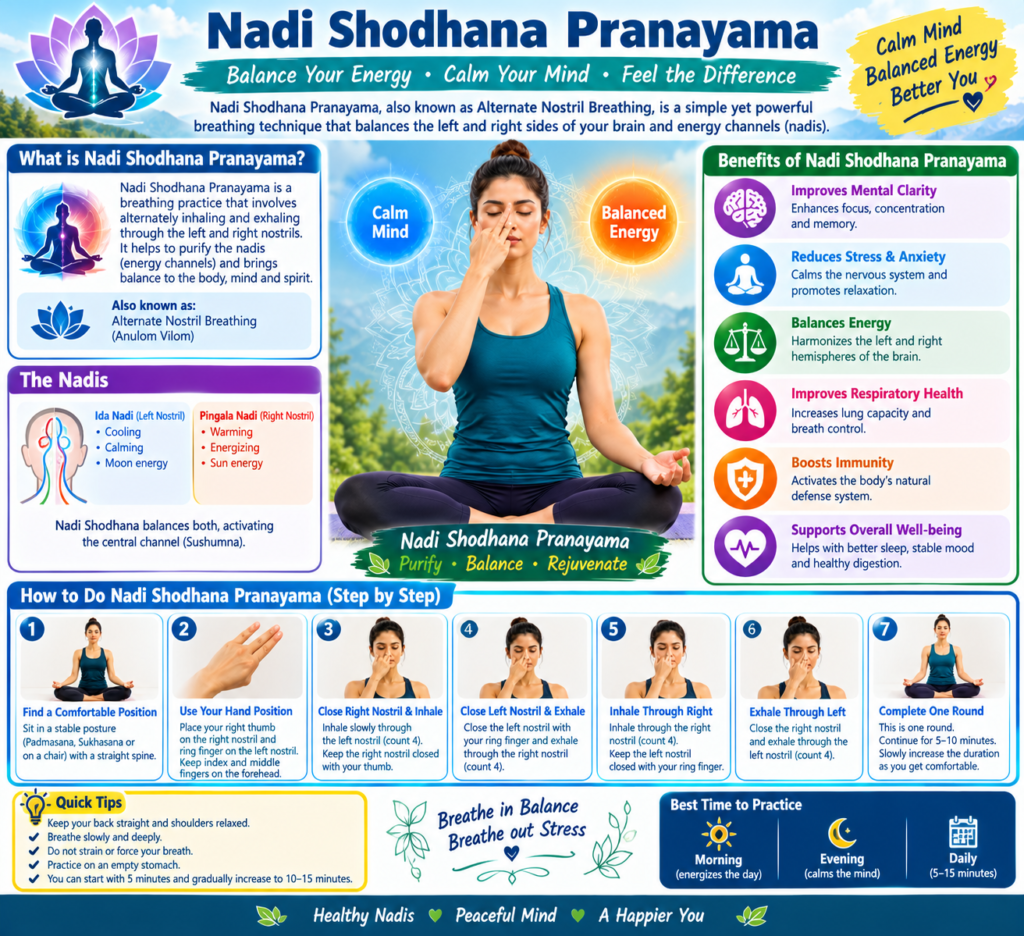
Nadi Shodhana Pranayama is a traditional yogic breathing technique commonly known as alternate nostril breathing. It involves breathing through one nostril at a time while gently closing the other nostril with the fingers. This practice is widely used in yoga to develop breathing awareness, encourage relaxation, and prepare the mind for meditation.
The Sanskrit term Nadi Shodhana is commonly translated as “channel purification.” In traditional yogic philosophy, nadis are subtle channels associated with the movement of prana, or vital energy. Shodhana means purification or cleansing. According to this traditional understanding, the practice helps balance the body’s subtle energy channels.
From a modern perspective, alternate nostril breathing is a structured breathing exercise that encourages attention to the breath and may support relaxation. However, claims about balancing subtle energy channels are part of traditional yoga philosophy and have not been established as anatomical facts by modern science.
One reason Nadi Shodhana is popular is that it can be practiced gently without complicated movements or special equipment. People often include it in their daily yoga routines, meditation sessions, or relaxation practices.
In this comprehensive guide, you will learn what Nadi Shodhana Pranayama is, how to perform it correctly, its potential benefits, common mistakes, safety precautions, and how to incorporate it into your daily routine.
1. What Is Nadi Shodhana Pranayama?
Nadi Shodhana Pranayama is a breathing practice in which inhalation and exhalation are performed alternately through the left and right nostrils.
The technique generally involves closing one nostril while breathing through the other, then switching sides in a controlled pattern.
Unlike vigorous breathing techniques, traditional beginner versions of Nadi Shodhana usually emphasize slow, comfortable, and steady breathing.
The practice encourages the practitioner to focus on the sensation of air moving through the nostrils and to maintain awareness of each inhalation and exhalation.
Nadi Shodhana is often practiced before meditation because it provides a simple focal point for attention. When the mind wanders, practitioners gently return their awareness to the breath.
Although traditional yoga describes this practice in terms of prana and subtle energy channels, modern explanations focus more on controlled breathing, attention, and possible effects on relaxation.
The practice should remain comfortable. Beginners do not need to hold their breath, breathe forcefully, or attempt advanced techniques to benefit from developing breathing awareness.
2. Meaning and Significance of Nadi Shodhana
The name Nadi Shodhana comes from two Sanskrit words.
- Nadi: A channel or pathway through which prana is traditionally understood to flow.
- Shodhana: Purification, cleansing, or refinement.
Together, Nadi Shodhana is commonly translated as “purification of the nadis.”Nadi Shodhana Pranayama: Benefits, Steps
Traditional yoga philosophy describes several important nadis, including Ida, Pingala, and Sushumna.
Ida is traditionally associated with the left side and qualities such as calmness and cooling. Pingala is associated with the right side and qualities such as activity and warmth. Sushumna is described as the central channel in yogic subtle-body traditions.
These concepts belong to the traditional framework of yoga philosophy rather than established anatomical structures.
In yoga practice, alternate nostril breathing is used to cultivate balance, steadiness, and concentration. Practitioners often follow it with meditation or other gentle breathing exercises.
Regardless of one’s interpretation of traditional concepts, the practice offers an opportunity to slow down, observe breathing, and bring attention to the present moment.
3. Benefits of Nadi Shodhana Pranayama
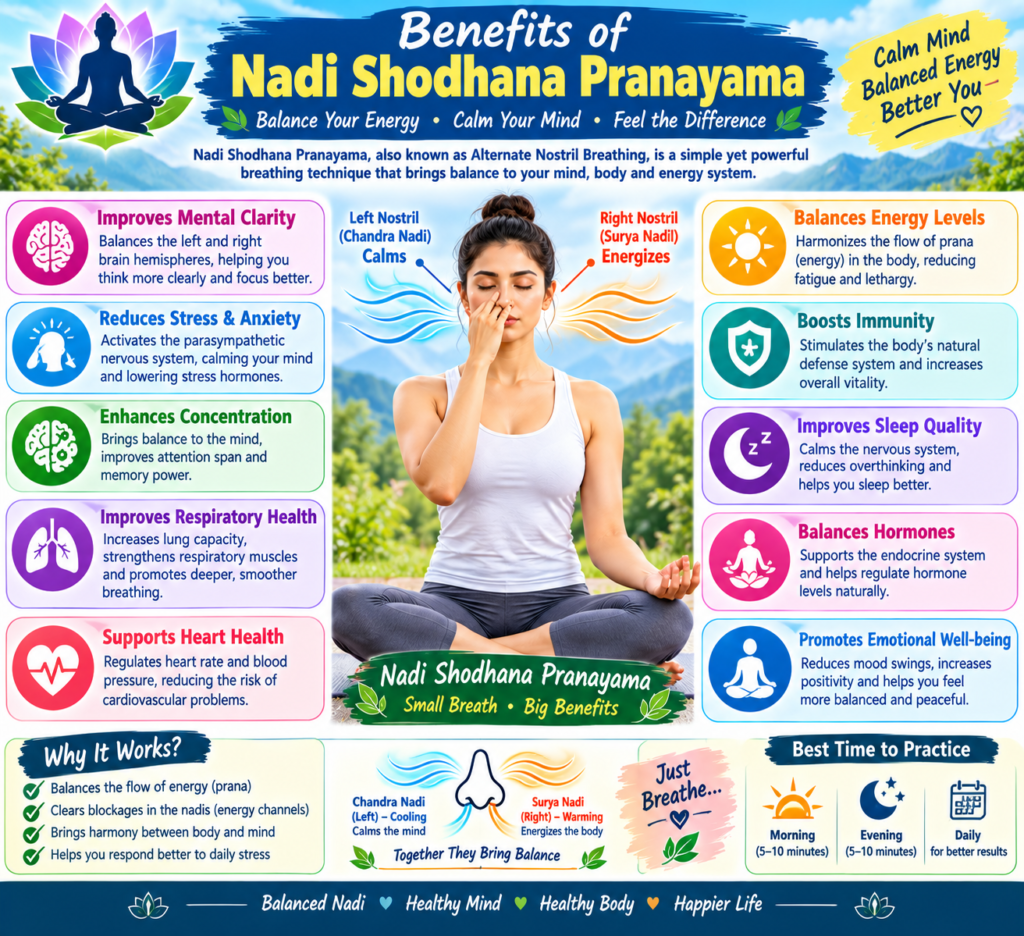
Nadi Shodhana is associated with several traditional benefits. Scientific research on alternate nostril breathing has explored possible effects on stress, cardiovascular measures, and breathing patterns, but the evidence varies in quality and does not establish every traditional claim.
1. May Promote Relaxation
Slow, comfortable breathing can help some people feel calmer.
Nadi Shodhana provides a structured way to focus on the breath rather than distracting thoughts. This may make it useful as part of a relaxation routine.
Individual responses differ, and the practice should not be forced if it creates discomfort.
2. Encourages Concentration
The alternating breathing pattern requires attention to the nostrils, fingers, and rhythm of breathing.
This repeated focus may help practitioners develop greater awareness and concentration during yoga or meditation.
When attention wanders, practitioners can gently return to the next breath without criticizing themselves.
3. Develops Breathing Awareness
Nadi Shodhana encourages people to notice the length, rhythm, and sensation of inhalation and exhalation.
Over time, this awareness may help practitioners recognize when their breathing becomes hurried or uncomfortable.
The aim is not to take the deepest possible breath but to breathe steadily and comfortably.
4. May Help Manage Everyday Stress
Breathing exercises are commonly used as complementary tools for managing everyday stress.
For some people, a few minutes of quiet, attentive breathing can provide a useful pause during a busy day.
However, Nadi Shodhana is not a substitute for professional mental health care when stress, anxiety, or other symptoms significantly affect daily life.
5. May Influence Certain Cardiovascular Measures
Some small studies of alternate nostril breathing and related breathing practices have reported changes in heart rate, blood pressure, or other physiological measures.
However, findings are not uniform, and the evidence is insufficient to conclude that Nadi Shodhana reliably treats high blood pressure or prevents cardiovascular disease.
People with cardiovascular conditions should follow their healthcare professional’s advice.
6. Supports Meditation Practice
Nadi Shodhana is often used before meditation because it gives the mind a clear and repetitive focus.
After completing the breathing exercise, practitioners may sit quietly and observe their natural breathing.
This transition can help establish a consistent meditation routine.
7. Requires Little Equipment
The practice can be performed while sitting comfortably on a mat, cushion, or chair.
It does not require exercise equipment, a large space, or complicated movements.
This makes it relatively easy to incorporate into a daily routine when practiced safely.
8. Encourages Mind-Body Awareness
By coordinating finger movements with breathing, practitioners become more aware of physical sensations and their breathing rhythm.
This awareness is a common feature of many yoga and mindfulness practices.
Important: Nadi Shodhana should not be presented as a cure for asthma, heart disease, high blood pressure, or mental health conditions. It is best considered a possible complement to a broader approach to health and well-being.
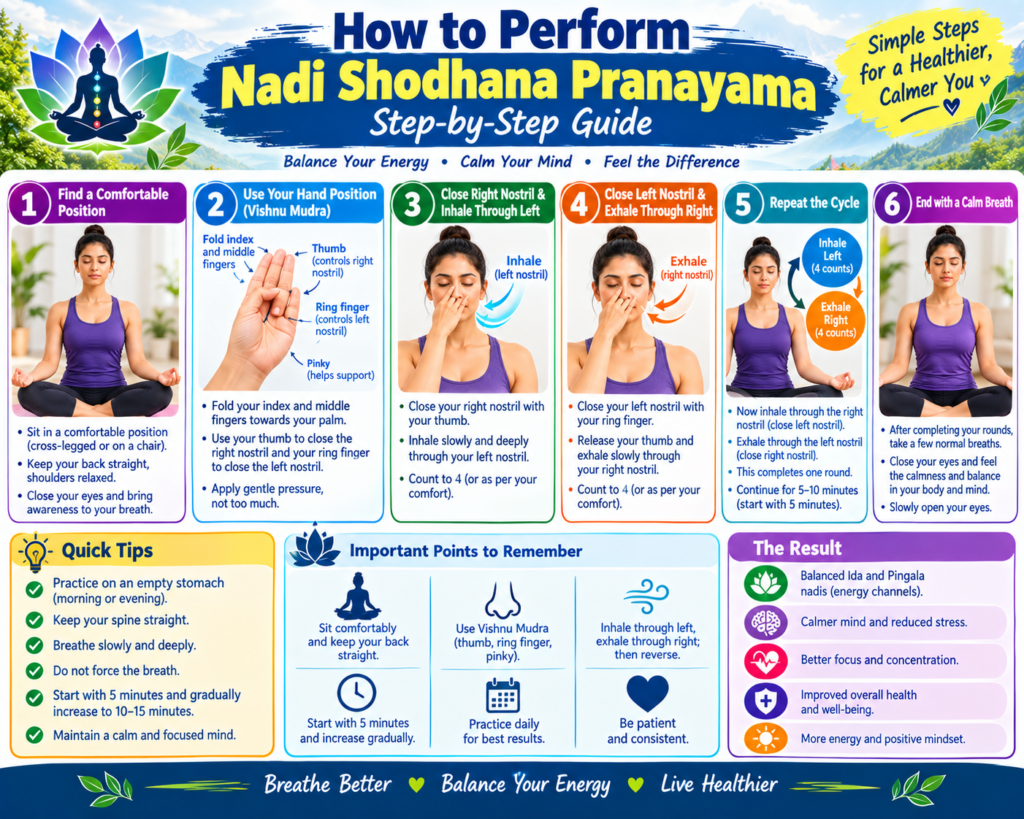
4. How to Perform Nadi Shodhana Pranayama: Step-by-Step Guide
Beginners should start with the basic version, without breath retention.
Step 1: Choose a Quiet Place
Find a comfortable, well-ventilated place where you can sit without interruption.
Choose a time when you are not rushing or immediately recovering from strenuous exercise.
Many people prefer practicing in the morning, but another quiet time is also suitable.
Step 2: Sit Comfortably
Sit on a yoga mat or cushion in a comfortable cross-legged position.
You may also sit upright on a chair with your feet resting on the floor.
Keep your spine naturally upright, your shoulders relaxed, and your face free of unnecessary tension.
Avoid forcing your back into a rigid position.
Step 3: Relax Your Body
Rest your left hand on your left knee or thigh.
Allow your shoulders and jaw to relax.
Close your eyes if comfortable, or maintain a soft gaze.
Take several natural breaths through both nostrils before beginning.
Step 4: Position Your Right Hand
A commonly taught method uses the right hand to control the nostrils.
Gently use your right thumb to close the right nostril and your ring finger to close the left nostril.
The index and middle fingers may rest lightly near the space between the eyebrows or fold toward the palm, depending on the tradition.
This hand position is commonly called Vishnu Mudra in yoga instruction.
Use only enough pressure to close the nostril comfortably. Never press hard against the nose.
Step 5: Exhale Gently
Begin by exhaling naturally through both nostrils.
Then close the right nostril with your right thumb.
Allow the left nostril to remain open.
Step 6: Inhale Through the Left Nostril
Breathe in gently and comfortably through the left nostril.
Avoid pulling in an unusually large breath or making the inhalation excessively long.
Step 7: Switch Nostrils
Close the left nostril with your ring finger and release your thumb from the right nostril.
Exhale gently through the right nostril.
This completes the first inhalation-exhalation sequence on the left side.
Step 8: Inhale Through the Right Nostril
Keeping the left nostril closed, inhale gently through the right nostril.
Maintain a relaxed posture and comfortable breathing rhythm.
Step 9: Exhale Through the Left Nostril
Close the right nostril with your thumb and release the left nostril.
Exhale gently through the left nostril.
You have now completed one full round of alternate nostril breathing:
Left inhalation → Right exhalation → Right inhalation → Left exhalation.
Step 10: Continue at a Comfortable Pace
Repeat the sequence without rushing.
Keep your breathing smooth and quiet. There is no need to produce loud breathing sounds or force air through a blocked nostril.
If you feel uncomfortable, stop and return to natural breathing through both nostrils.
Step 11: Finish the Practice
After a few rounds, release your hand and breathe normally through both nostrils.
Sit quietly for a short time and notice how you feel.
Stand up slowly when you are ready.
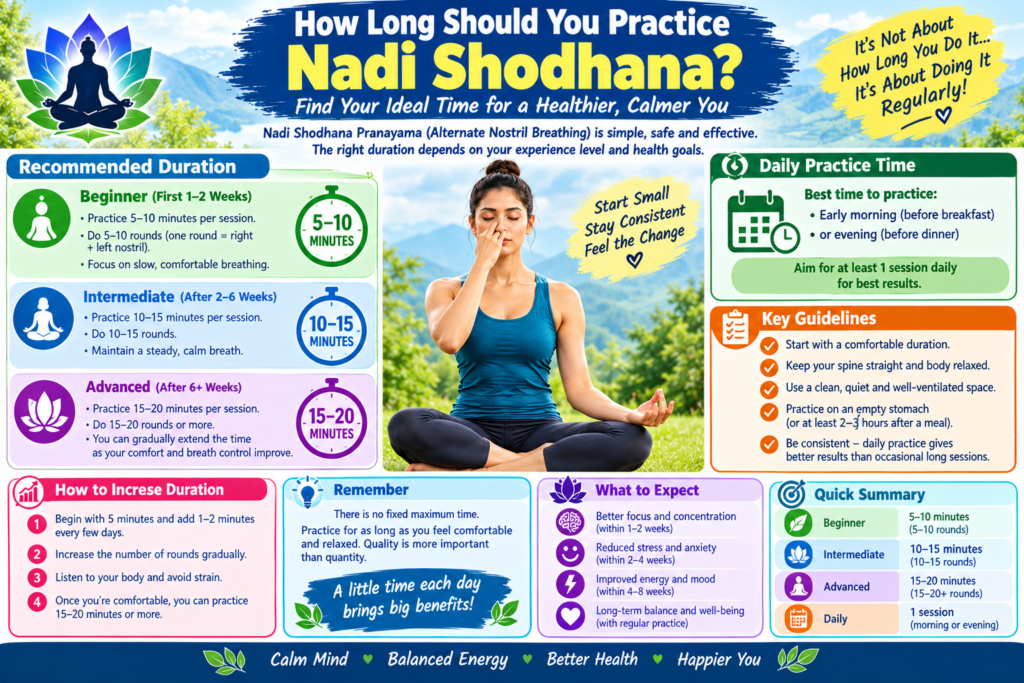
5. How Long Should You Practice Nadi Shodhana?
There is no single duration that is best for everyone.
Beginners may start with approximately two to five minutes of comfortable alternate nostril breathing.
If the practice feels easy and remains comfortable, the duration can gradually increase according to personal preference and instructor guidance.
Consider these principles:
- Prioritize comfort rather than the number of rounds.
- Keep inhalation and exhalation natural and unforced.
- Do not hold your breath when learning the basic technique.
- Stop if you experience dizziness, breathlessness, or discomfort.
- Avoid continuing simply to reach a predetermined duration.
A short, comfortable practice is preferable to a longer session that causes strain.
6. Best Time to Practice Nadi Shodhana
Nadi Shodhana can be practiced at different times of the day, depending on personal preference.
Morning
Some people prefer morning practice because it provides a quiet start to the day and can be incorporated into a regular yoga routine.
Before Meditation
Practicing alternate nostril breathing before meditation can provide a clear focus for attention.
During a Quiet Break
A short session may be useful when you want to pause and focus on your breathing.
Choose a time when you can sit comfortably without rushing.
Avoid practicing immediately after a heavy meal if it makes you uncomfortable.
There is no requirement to practice at a particular hour for the technique to be meaningful.
7. Common Mistakes to Avoid
Breathing Too Forcefully
Forceful inhalation and exhalation can create unnecessary tension.
Solution: Breathe gently and let the air move naturally.
Holding the Nose Too Tightly
Pressing too hard can cause discomfort.
Solution: Use light finger pressure to close each nostril.
Raising the Shoulders
Excessive shoulder movement can make breathing feel tense.
Solution: Keep your shoulders relaxed and allow your chest and abdomen to move naturally.
Trying to Breathe for Too Long
Extending each inhalation or exhalation beyond your comfortable capacity may cause air hunger.
Solution: Use a natural, manageable rhythm without forcing a particular duration.
Practicing with a Blocked Nose
A severe cold, nasal congestion, or another condition may make the practice uncomfortable.
Solution: Wait until breathing through the nose is comfortable, or ask a healthcare professional whether a modified practice is suitable.
Adding Breath Retention Too Early
Some advanced pranayama methods include holding the breath, but this is not necessary for beginners.
Solution: Learn alternate nostril breathing without retention before considering advanced variations with a qualified instructor.
8. Precautions and Who Should Be Careful
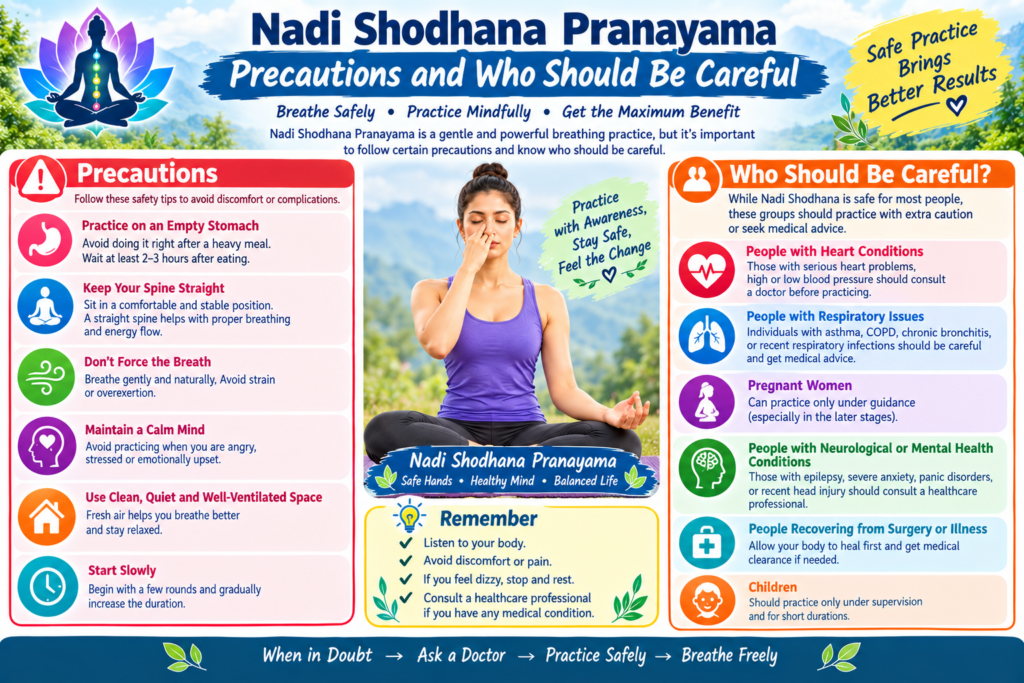
Gentle alternate nostril breathing is generally manageable for many healthy adults, but the technique should be adapted to individual needs.
Consider the following precautions:
- Do not force air through a blocked nostril.
- Avoid breath retention if you are inexperienced.
- Stop if you experience dizziness, chest discomfort, or unusual shortness of breath.
- Do not use the technique as a substitute for prescribed medication.
- Seek medical advice before practicing if you have a significant heart or lung condition, recurrent fainting, or another condition that affects breathing.
- If breathing exercises trigger panic or discomfort, stop and consider a gentler approach.
Pregnant people and individuals with specific medical conditions should ask their healthcare professional about suitability, particularly before attempting advanced breathing techniques.
If you experience severe chest pain, fainting, or significant difficulty breathing, seek urgent medical care.
9. Difference Between Nadi Shodhana and Anulom Vilom
Nadi Shodhana and Anulom Vilom are often used interchangeably in modern yoga instruction.
Both commonly involve alternating inhalation and exhalation between the left and right nostrils.
However, terminology and technique can differ between yoga schools.
Some traditions distinguish Nadi Shodhana by including specific breathing ratios, breath retention, or additional practices. Other teachers use the terms for essentially the same basic alternate nostril breathing exercise.Bhastrika Pranayama: Benefits
For beginners, the most important considerations are proper technique, comfortable breathing, and avoiding unnecessary strain.
You do not need to perform advanced variations to begin learning alternate nostril breathing.
10. How to Include Nadi Shodhana in a Daily Yoga Routine
A balanced yoga routine can combine gentle movement, breathing awareness, relaxation, and meditation.
For example, you might follow this simple sequence:
- Sit comfortably for one minute.
- Observe your natural breathing for one or two minutes.
- Practice gentle Nadi Shodhana for two to five minutes.
- Release your hand and return to natural breathing.
- Sit quietly for a few minutes.
- Continue with meditation or another comfortable yoga practice if desired.
This is only an example, not a medical prescription or a requirement.
You can shorten the session if you feel uncomfortable or prefer a brief practice.
Consistency is more important than intensity. The aim is to develop a comfortable relationship with breathing rather than forcing yourself to achieve a particular result.Blood Flow Through the Heart
11. Scientific Perspective on Alternate Nostril Breathing
Research into alternate nostril breathing has explored its possible effects on the autonomic nervous system, heart rate, blood pressure, and psychological well-being.
Some small studies have reported potentially beneficial changes in selected physiological measures. However, research methods and results vary, and many studies have limitations, including small participant groups and differences in breathing protocols.
It is therefore important to distinguish preliminary findings from established medical evidence.
Nadi Shodhana may help some people feel calmer because it provides a structured opportunity to focus on slow, comfortable breathing.
However, researchers have not established that it reliably removes toxins, purifies anatomical energy channels, cures disease, or guarantees a particular change in blood pressure.
For general health, alternate nostril breathing can be considered a complementary practice alongside regular physical activity, adequate sleep, balanced nutrition, and appropriate medical care.
12. Frequently Asked Questions About Nadi Shodhana Pranayama
What is Nadi Shodhana Pranayama?
Nadi Shodhana is a traditional yogic breathing exercise commonly known as alternate nostril breathing. It involves inhaling and exhaling through one nostril at a time.Health Benefits of Nadi Shodhana Pranayama
What are the main benefits of Nadi Shodhana?
The practice may encourage relaxation, breathing awareness, concentration, and preparation for meditation. Scientific evidence for specific medical benefits remains limited.
Can beginners practice Nadi Shodhana?
Yes, many beginners can learn the gentle version without breath retention. Start with a short session and maintain a comfortable rhythm.
How many minutes should I practice?
Beginners may start with two to five minutes, provided the practice remains comfortable. There is no requirement to complete a fixed number of rounds.
Is Nadi Shodhana the same as Anulom Vilom?
The terms are often used interchangeably, although some yoga traditions distinguish the techniques based on breathing ratios, retention, or other details.
Should I hold my breath during Nadi Shodhana?
Breath retention is not necessary for the basic technique. Beginners should breathe continuously and comfortably unless a qualified instructor has specifically taught an appropriate advanced method.
Can Nadi Shodhana cure anxiety?
It is not an established cure for anxiety disorders. Some people may find gentle breathing helpful as part of stress management, but persistent or severe anxiety may require professional care.
What should I do if one nostril is blocked?
Do not force air through the blocked nostril. Wait until nasal breathing is comfortable or seek medical advice if the blockage persists.Nadi Shodhana Pranayama: Procedure, Steps, Benefits
Conclusion
Nadi Shodhana Pranayama is a traditional yogic breathing technique that alternates inhalation and exhalation between the left and right nostrils.
Its simple method makes it accessible to many people who want to develop breathing awareness, improve concentration, and include a quiet breathing practice in their daily routine.
The basic technique involves sitting comfortably, gently closing one nostril at a time, breathing without strain, and returning to natural breathing after the practice.
Traditional yoga philosophy associates Nadi Shodhana with the purification of subtle energy channels. Modern research has investigated possible effects on relaxation and physiological measures, but stronger evidence is needed to establish specific medical benefits.
Beginners should focus on comfort rather than speed or duration. Breath retention and advanced variations are unnecessary when learning the basic technique.
The key to Nadi Shodhana Pranayama is gentle, steady, and mindful breathing. Practiced appropriately, it can be a useful addition to a broader routine of yoga, meditation, and healthy living.
Image Alt Text: Nadi Shodhana Pranayama alternate nostril breathing technique demonstrated in a seated yoga posture.
Related Keywords:
- Nadi Shodhana Pranayama benefits
- How to do Nadi Shodhana
- Alternate nostril breathing
- Anulom Vilom Pranayama
- Nadi Shodhana steps
- Nadi Shodhana breathing technique
- Pranayama for beginners
- Yoga breathing exercises
- Nadi Shodhana precautions
- Breathing exercises for relaxation