

Brain-Boosting Foods: Best Foods for Memory, Focus & Overall Brain Health
Brain-Boosting Foods: Best Foods for Memory, Focus & Brain Health
Meta Description
Discover 20 brain-boosting foods that support memory, concentration and overall brain health, including berries, leafy greens, fatty fish, nuts, eggs, whole grains and more.
Introduction
Your brain needs a steady supply of energy and nutrients to function properly. Instead of looking for one “magic” brain food, research generally supports an overall healthy eating pattern rich in vegetables, fruits, whole grains, legumes, nuts, seeds, fish and healthy fats.
Recent research also continues to associate healthy dietary patterns such as Mediterranean-, DASH- and MIND-style diets with better long-term cognitive health. However, these studies do not prove that a particular food can prevent dementia or guarantee better memory.
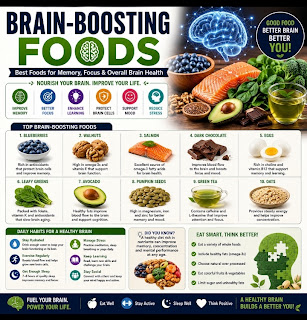
20 Best Brain-Boosting Foods
1. Fatty Fish
Salmon, sardines, trout and mackerel provide omega-3 fatty acids, particularly DHA and EPA.
Why they’re useful: Omega-3 fats are important components of brain cell membranes, and fish consumption is associated with brain health.
2. Blueberries
Blueberries contain flavonoids and other plant compounds.
Potential benefit: Regular berry consumption has been associated with better memory in observational research.
3. Strawberries
Strawberries are rich in vitamin C and flavonoids.
Add them to:
- Oatmeal
- Yogurt
- Smoothies
- Fruit bowls
4. Spinach
Spinach provides folate, vitamin K, carotenoids and other nutrients.
Leafy green vegetables are a key component of brain-healthy dietary patterns.
5. Broccoli
Broccoli provides fiber, vitamin C, vitamin K and plant compounds.
It’s an easy addition to soups, salads, stir-fries and meals.
6. Walnuts
Walnuts provide healthy fats, including plant-based omega-3 ALA, along with protein and other nutrients.
They’re a convenient snack when eaten in appropriate portions.
7. Almonds
Almonds provide vitamin E, healthy fats, protein and minerals.
Try adding a small handful to breakfast or using them as a snack.
8. Eggs
Eggs provide protein and are a source of choline.
Choline is involved in the production of acetylcholine, a neurotransmitter important for attention and memory.
9. Oats
Oats provide complex carbohydrates and fiber.
A balanced oatmeal breakfast can provide steady nourishment while also allowing you to add berries, nuts and seeds.
10. Whole Grains
Brown rice, whole-wheat roti, quinoa, barley and whole-grain bread provide carbohydrates and fiber.
Whole grains are emphasized in Mediterranean and MIND-style eating patterns.
11. Avocados
Avocados provide monounsaturated fats, fiber and several vitamins and minerals.
Use them in salads, sandwiches or whole-grain toast.
12. Beans
Beans and legumes provide fiber, plant protein, folate and other nutrients.
They are an important part of several healthy dietary patterns.
13. Lentils
Lentils are an affordable source of plant protein, fiber, folate, iron and other nutrients.
Try:
- Dal
- Lentil soup
- Lentil salad
- Vegetable dal
14. Pumpkin Seeds
Pumpkin seeds provide healthy fats, protein, magnesium, zinc and other nutrients.
Sprinkle them over oatmeal, salads or yogurt.
15. Chia Seeds
Chia seeds provide fiber, healthy fats and plant-based ALA omega-3 fatty acids.
Add them to yogurt, oatmeal or smoothies.
16. Olive Oil
Extra-virgin olive oil is a source of monounsaturated fat and is commonly used in Mediterranean-style eating patterns.
Use it as part of a balanced diet rather than treating it as a medicine.
17. Yogurt
Yogurt provides protein and nutrients such as calcium and B vitamins. Some yogurts also contain live cultures.
A balanced diet that supports gut health may also contribute to overall well-being, although the relationship between gut microbes and cognitive health is still being studied.
18. Oranges
Oranges provide vitamin C, water and plant compounds.
Other citrus fruits can also be included as part of a varied diet.
19. Green Tea
Green tea contains caffeine and plant compounds called catechins.
It can be a lower-calorie alternative to sugary beverages when consumed without excessive added sugar.
20. Dark Leafy Greens
Kale, collard greens, mustard greens and other leafy vegetables provide folate, vitamin K, carotenoids and other nutrients associated with healthy dietary patterns.
Best Nutrients for Brain Health
Omega-3 Fatty Acids
Found in:
- Salmon
- Sardines
- Mackerel
- Walnuts
- Flaxseeds
- Chia seeds
Antioxidant Plant Compounds
Found in:
- Berries
- Leafy greens
- Colorful vegetables
- Tea
Folate
Found in:
- Lentils
- Beans
- Spinach
- Broccoli
- Other leafy vegetables
Vitamin E
Found in:
- Almonds
- Sunflower seeds
- Nuts
- Seeds
- Avocado
Choline
Found in:
- Eggs
- Fish
- Dairy
- Beans
- Cruciferous vegetables
- Nuts and seeds
Choline contributes to the production of acetylcholine and is involved in normal brain function.
Simple Ways to Boost Your Immunity Naturally: 10 Healthy Lifestyle Tips
Best Brain-Healthy Diet Pattern
Rather than concentrating on one food, build meals around a variety of nutritious foods.
A Mediterranean- or MIND-style pattern commonly emphasizes:
- Green leafy vegetables
- Other vegetables
- Berries
- Whole grains
- Beans
- Nuts
- Fish
- Olive oil
- Moderate amounts of poultry and dairy
- Less red meat
- Fewer sweets and highly processed foods
A 2026 Harvard review of more than 159,000 people found that several healthy dietary patterns were associated with better cognitive functioning later in life, with particularly strong associations for a DASH-style diet. The research was observational, so it cannot prove that diet alone caused the differences.
Simple Brain-Healthy Meal Ideas
Breakfast
Oatmeal + blueberries + walnuts + yogurt
Lunch
Spinach salad + chickpeas + vegetables + olive oil
Snack
Apple or berries + a small portion of nuts
Dinner
Grilled fish + broccoli + brown rice
Vegetarian Dinner
Lentil dal + vegetables + whole-grain roti
Simple Ways to Boost Your Immunity Naturally: 10 Healthy Lifestyle Tips
Foods to Limit for Better Overall Health
There is no need to label individual foods as completely “brain-damaging.” Instead, focus on your overall eating pattern.
Try to limit excessive intake of:
- Highly processed foods
- Foods high in added sugar
- Excess sodium
- Foods high in saturated fat
- Deep-fried foods
- Excessive sweets
- Excessive alcohol
The MIND diet, for example, emphasizes plant foods and limits foods such as pastries, sweets, fried foods and high amounts of red meat.
Benefits of Brain-Healthy Eating
A nutritious eating pattern can help support:
- Normal brain function.
- Memory and concentration.
- Cardiovascular health.
- Healthy blood vessels.
- Stable energy levels.
- Overall nutrition.
- Healthy aging.
- Heart health.
- Digestive health.
- General physical and mental well-being.
Because the brain depends on healthy blood flow and overall metabolic health, dietary patterns that support cardiovascular health may also benefit brain health.
Symptoms of Poor Brain Health
Possible concerns can include:
- Persistent difficulty concentrating
- Forgetfulness that interferes with daily life
- Difficulty finding familiar words
- Confusion
- Changes in judgment
- Problems completing familiar tasks
Occasional forgetfulness is common and doesn’t automatically indicate a disease. However, noticeable or worsening cognitive changes should be discussed with a healthcare professional.
Causes That Can Affect Memory and Concentration
Memory and concentration can be affected by many factors, including:
- Poor sleep
- Chronic stress
- Lack of physical activity
- Poor nutrition
- Dehydration
- Certain medications
- Alcohol or substance use
- Depression or anxiety
- Some medical conditions
- Aging-related changes
Nutrition is only one part of brain health.
Simple Ways to Boost Your Immunity Naturally: 10 Healthy Lifestyle Tips
Prevention & Brain Health Tips
For long-term brain health, combine a nutritious diet with:
- Regular physical activity
- Adequate sleep
- Healthy blood pressure management
- Social connection
- Mental stimulation
- Stress management
- Avoiding tobacco
- Limiting excessive alcohol
- Regular healthcare when appropriate
Harvard’s current guidance similarly emphasizes a combination of healthy diet, physical activity, quality sleep, cognitive engagement, social connection and stress management.
FAQ
What are the best brain-boosting foods?
Some of the most commonly recommended foods include fatty fish, berries, leafy greens, nuts, whole grains, beans, eggs, vegetables and olive oil.
What food is best for memory?
There isn’t one proven “best” food for memory. A varied diet rich in vegetables, berries, whole grains, beans, nuts and fish is more strongly supported than relying on a single food.
Are walnuts good for the brain?
Walnuts provide healthy fats, including plant-based omega-3 ALA, and can be included as part of a balanced diet.
Are eggs good for brain health?
Eggs provide choline, a nutrient involved in normal brain function and neurotransmitter production.
Is fish good for memory?
Fish provides omega-3 fatty acids, and higher fish intake has been associated with better cognitive health in observational research.
Are berries good for the brain?
Berries contain flavonoids and other plant compounds. Research has linked berry consumption with aspects of memory and cognitive health, although this doesn’t prove berries prevent cognitive decline.
What is the MIND diet?
MIND stands for Mediterranean-DASH Intervention for Neurodegenerative Delay. It combines aspects of the Mediterranean and DASH diets and emphasizes leafy greens, berries, whole grains, beans, nuts, fish and olive oil.
Can food prevent dementia?
No individual food has been proven to prevent Alzheimer’s disease or age-related cognitive decline. Overall dietary patterns may be associated with better brain health, but more research is needed to establish cause and effect.
Do brain supplements work?
Current evidence does not establish that over-the-counter “brain supplements” reliably improve thinking or prevent memory loss in healthy people. A food-first approach is generally preferable unless a healthcare professional recommends supplementation for a specific reason.
How can I improve brain health naturally?
Eat a varied nutritious diet, exercise regularly, sleep adequately, manage stress, stay socially connected and keep your cardiovascular risk factors under control.
Conclusion
Brain health starts with an overall healthy lifestyle—not one miracle food. Include colorful vegetables, leafy greens, berries, whole grains, beans, nuts, seeds, fish and healthy fats regularly.
A Mediterranean-, DASH- or MIND-style eating pattern can provide a practical framework for building a brain-friendly diet. Research suggests these patterns are associated with better cognitive health, but they should be viewed as part of an overall healthy lifestyle rather than a guaranteed treatment or cure.
Tags
Brain-Boosting Foods, Brain Health, Foods for Memory, Foods for Focus, Cognitive Health, Healthy Brain Foods, Memory Foods, Brain Nutrition, Healthy Diet, MIND Diet, Mediterranean Diet, Healthy Aging, Wellness
SEO Keywords
- brain-boosting foods
- best foods for brain health
- foods for memory
- foods to improve memory
- foods for concentration
- foods for focus
- healthy brain foods
- brain health diet
- best foods for cognitive health
- foods that support memory
- brain healthy diet
- MIND diet foods
- Mediterranean diet for brain health
- omega 3 foods for brain
- foods for healthy aging
Hashtags
#BrainBoostingFoods #BrainHealth #MemoryFoods #HealthyBrain #CognitiveHealth #BrainFood #HealthyEating #Nutrition #HealthyLifestyle #MINDDiet #MediterraneanDiet #HealthyAging #Wellness #HealthTips #HealthyLiving